Alaska 2025 - final thoughts
We had a truly amazing experience traveling in Alaska and northern Canada this summer. Every week was filled with beauty and adventure. But even in this great experience, some things stood out. We discussed this a lot during the long drive home. Here are a few closing thoughts, some of which may be useful if you're considering an Alaska vacation yourself.
Best of the Best
- Bear viewing at Katmai National Park. It was truly an awesome experience to see so many bears, so close. We enjoyed this so much that we plan to enter the Brooks Lodge Lottery just for the chance to return for a multi-day visit.
- Wrangell-St. Elias National Park (USA) and Kluane National Park (Canada). In a region filled with beauty, Kluane stands out with majestic mountains and gorgeous lakes. We also loved the chance to explore the interior of Wrangell-St. Elias, particularly the mine tour and the walk on the Root Glacier. These sister-parks are less popular but absolutely worth a visit.
- Teklanika Campground in Denali National Park. It was beautiful and exciting to drive beyond the public roads to reach the secluded campground at "Tek". Plus, exploring the Denali backcountry was way more fun and interesting than the overcrowded front country.
- The Yukon. The drive to Alaska got more beautiful and interesting once we approached the Yukon. The Liard River Hot Springs* was a real treat and a bargain, too. The town of Whitehorse had the perfect balance of city amenities and wilderness views. And the George Johnston Museum in Teslin was fascinating, where George Johnston's early photographs illustrated life of the Tlingit people before the arrival of the highway and settlers. (* The Liard River Hot Springs is officially in BC but it's just minutes from the Yukon border).
- Seward. This was exactly what we were looking for in the Kenai Peninsula: a charming fishing town, with gorgeous views of the water, cute shops and restaurants, and access to the Exit Glacier. And the tour of the Seavey "Iditaride" dog kennel was fantastic. Amy expected Seward to be overrun by cruise ship passengers, but it did not feel crowded at all. In fact, it was Homer that felt crowded and touristy, despite that virtually no cruise ships stop in Homer.
- The 26 Glacier Cruise. Whittier is a sleepy town, but the 26 Glacier Cruise is worth the trip. The boat was more comfortable than most day cruises, and we got up close to so many glaciers in a single day.
- Visiting Glacier Bay by land. We've been to Glacier Bay before on a cruise ship, and it wasn't nearly as special as our visit on the day boat leaving from the lodge. On the day boat, we got far closer to the face of the glacier than the cruise ship, which was behind us! And with a smaller group, we got much more personal interaction with the park ranger. In addition to the day boat, kayaking at high tide in the Beardsley Islands was a big thrill.
Disappointments
- Most museums. We stopped at several small museums that had similar, poorly curated collections of taxidermy and household junk. One set of stuffed animals of the region (bear, wolf, eagles, etc.) is sufficient; it gets boring to see this again and again. And nobody is interested in the everyday, household items from the gold rush or from the days of building the highway, things like outboard motors, rusty old cars, drill bits, cans of food, etc. Here are the few exceptions that we truly enjoyed (sorry Phillipa, the Hammer Museum was only good for the ironic value):
- The Anchorage Museum
- Alaska Native Heritage Center (Anchorage)
- Yukon Beringia Interpretive Centre (Whitehorse)
- George Johnston Museum (Teslin, Yukon)
- MacBride Museum of Yukon History (Whitehorse)
- Prince William Sound Museum (Whittier)
- Fairbanks. We were glad to be in Fairbanks for the Midnight Sun Solstice Festival. Beyond that, with the exception of Pioneer Park, we found little worth visiting in Fairbanks. Whitehorse (Yukon) is more like we imagined Fairbanks to be. Go there instead.
- The Cassiar Highway. For most of the drive, there are two options for roads, which gives an option when road conditions like wildfires close one road. The Cassiar Highway is the alternative to the Alcan Highway, and we read in several places that the Cassiar Highway has better scenery and more wildlife. That wasn't our experience at all: it was less scenic, harder to drive, with far longer distances between amenities (fuel, campgrounds, etc.). And the total drive time is roughly the same. Given a choice, we'll take the Alcan next time.
Unexpected surprises
- Cruising can be a great way to experience Alaska. That's not a typo. Many of our best experiences were along the coast. If you make the effort to choose port excursions carefully (and we realize that's a big "if", Maria), you can see the same glaciers and wildlife that we saw on our RV adventure. It's not quite the same experience we had, but it's far more approachable.
- Good road conditions on the Alcan highway. Prior to driving the Alcan highway, you probably have a pre-conceived notion about terrible road conditions. This was almost completely false for us. The road conditions were excellent for nearly the entire drive, with only 2 exceptions. First, as expected for a region with harsh winters and a short summer, there were numerous long construction zones. Second, the section from Haines Junction (Yukon) to the US border was in poor condition, but this was only about 4 hours of driving. And based on the amount of construction, it wouldn't surprise us if this section gets repaired in a year or two. Apart from these two minor issues, the Alcan highway was easy driving.
- Lack of national chains. In the continental USA, practically every freeway exit has the same fast food restaurants and chain hotels. They may not be great, but you can expect a standard level of quality. In contrast, apart from the larger cities, there were no chains in British Columbia, Yukon or Alaska. Only small lodges and restaurants, with many built in the 1950s that seemed really run down.
- Lack of hotels along the drive. This isn't a problem if you're driving an RV, where there are many campgrounds plus many places where it's safe and legal to boondock (free camping in the wilderness). Otherwise, you have to plan your drive carefully around the occasional towns that have a lodge.
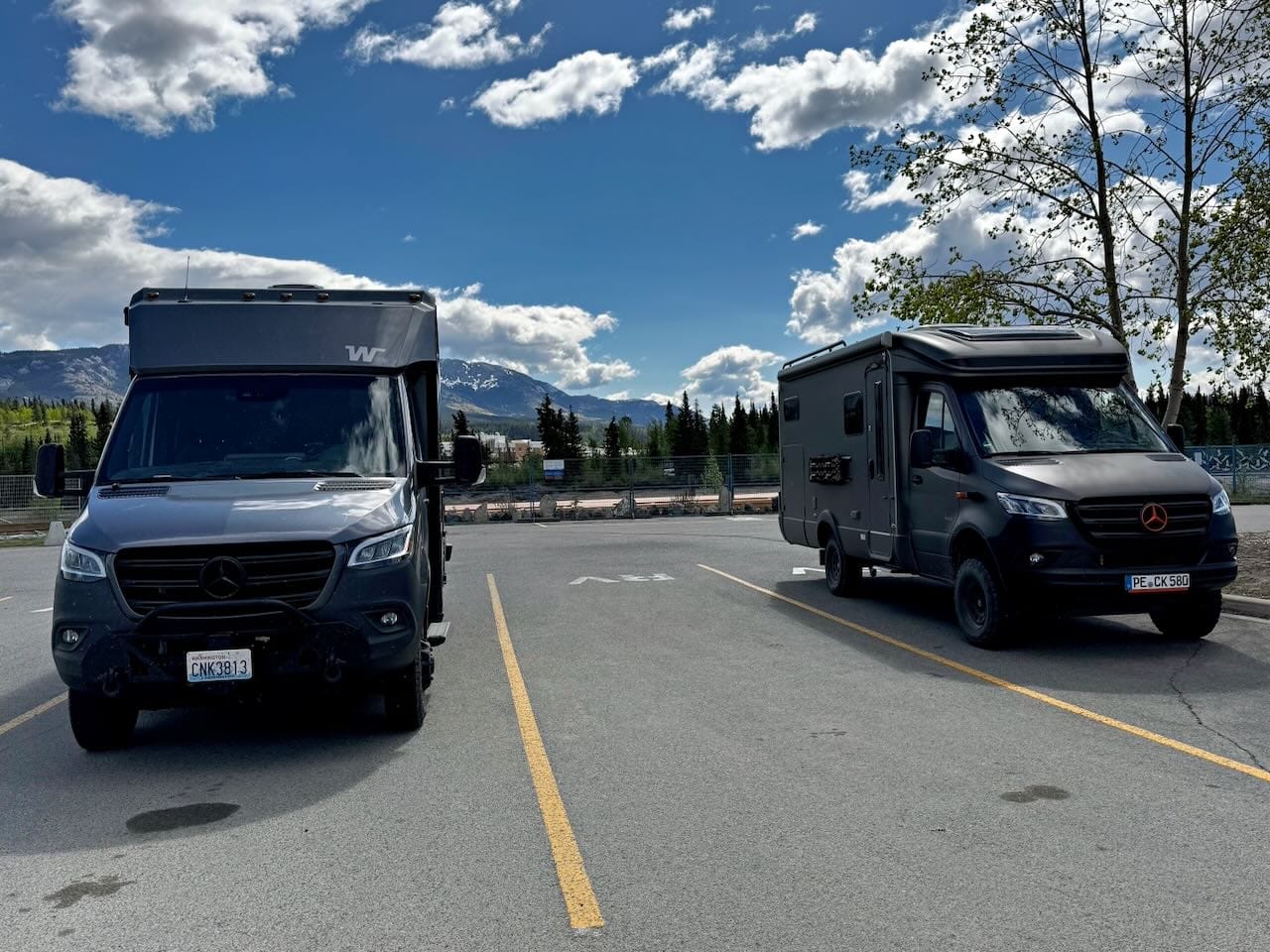
- The mix of RVs. We've read that towable trailers outsell drivable motorhomes about 10-to-1, which seems right based on our trips around the continental US and southern Canada. But driving in Alaska and the Yukon, it seems like the opposite: most visitors have a drivable motorhome. These motorhomes come in all shapes and sizes, including truck campers that sit on a pickup truck, adventure vehicles like our "R2V2", and even giant Class A (bus-like) motorhomes. Relatively few "towables" make the long drive to Alaska. Also, there were far more rented motorhomes than we see in the continental US; this can be a practical way to explore Alaska for international visitors or anyone who has limited time.
- The number of European RVs. Europeans - especially Germans - can be intrepid travelers. We weren't surprised that many fly to Alaska or Canada and rent an RV. What surprised us was to see dozens of motorhomes with European license plates in Alaska and Canada. Impressive.